Buyers agent for Laverton VIC3028
Your complete Laverton property guide
Your trusted guide to finding the perfect property in Laverton.
Book your free consultation
Trish Moore B.Bus (Acc) FCA
Principal Buyers Agent
Estate Agent Licence
VIC 087665L

Loading map...
What's it like living in Laverton?
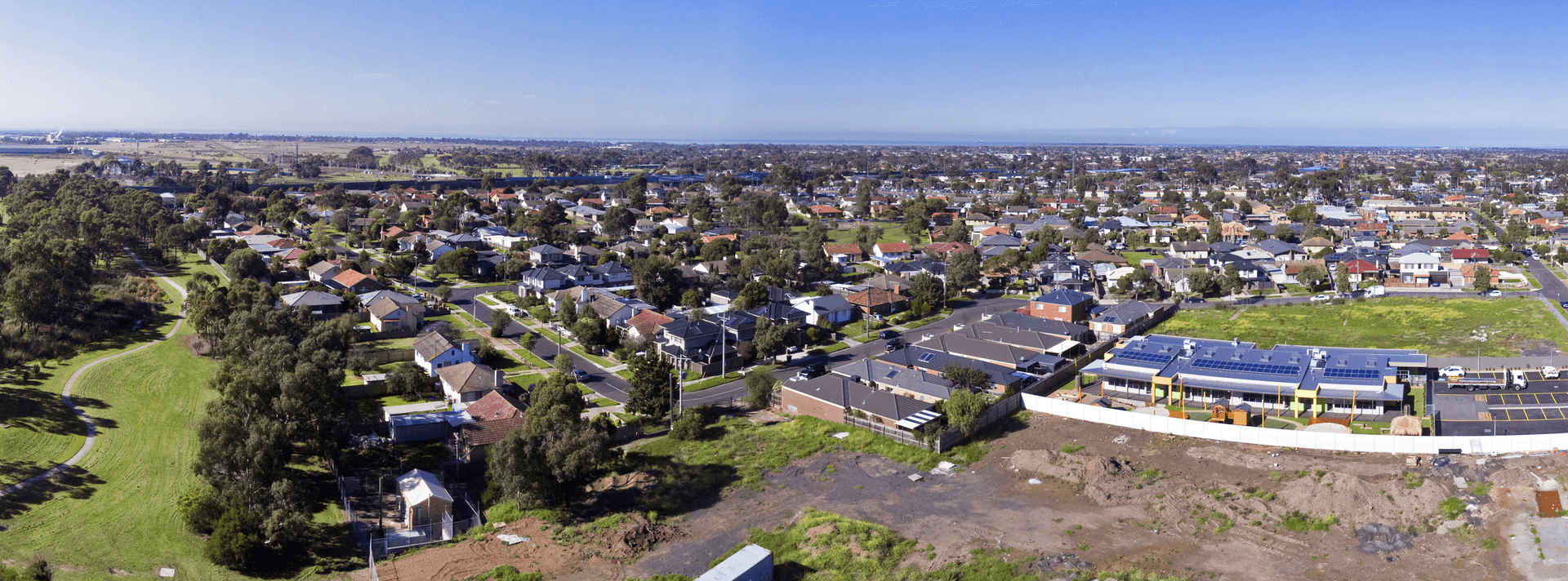
Laverton sits 17 kilometres southwest of Melbourne's CBD, straddling the Cities of Hobsons Bay and Wyndham, and it occupies just 3.8 square kilometres, making it one of the smaller suburbs in Melbourne's western corridor. The suburb recorded 4,760 residents at the 2021 census, down from 4,915 in 2016, representing a 3.2 per cent population decline bucking the explosive growth trend of surrounding western suburbs. Projections suggest Laverton will reach approximately 7,500 residents by 2031 as infill development and townhouse projects gradually increase density. The suburb was named after the Laverton pastoral run settled by Alfred Langhorne in 1836, promoted as a new and model suburb in 1886 by Staples Wise and Company on behalf of the Federal Investment Company of Australasia, with the Laverton railway station opening as the first stop beyond Newport on the line to Geelong.
Laverton's defining characteristic is RAAF Base Williams Laverton, the third oldest RAAF base in Australia, established in 1925 alongside RAAF Base Richmond following the success of the Australian Flying Corps in World War I. The base covers 148 hectares within the suburb and was originally established to support flying and maintenance activities after the formation of the RAAF in 1921. Lieutenant Colonel R. Williams served as its first commander, and the base was later named RAAF Williams in his honour. The base merged administratively with RAAF Base Point Cook in 1989 to form the combined RAAF Williams facility, with all administrative functions located at Laverton and Point Cook hosting the RAAF Museum. The Laverton runway was decommissioned in September 1996, and the western two-thirds of the former airfield was detached to create Williams Landing development suburb in 2008, complete with new railway station and bus interchange in 2013 and town centre in 2014-15.
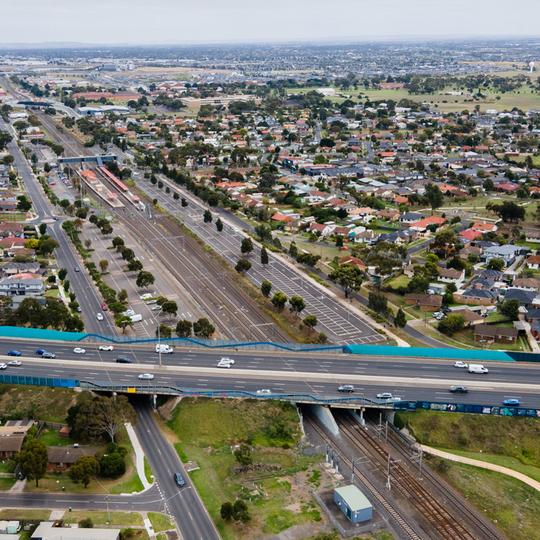
Today RAAF Williams Laverton houses Headquarters Air Force Training Group, the ADF School of Languages, Defence International Training Centre, Director General Technical Airworthiness, No. 21 Squadron RAAF Active Reserve, and elements of the 8th/7th Battalion Royal Victorian Regiment Australian Army Reserve, along with Defence Materiel Organisation sub-units. The base hosts the shotgun section location for the 1956 Summer Olympics shooting events, and in 1946 hosted the first flight of newly formed Trans Australia Airlines when Douglas DC-3 VH-AES Hawdon diverted from Essendon due to heavy rains. The Aircraft railway station near the base entrance serves military personnel and contractors, while Laverton Station serves the main residential area across the Princes Freeway.
The demographic profile establishes Laverton as a working-class suburb with significant multicultural composition and economic challenges. The median age sits at 31 years, with the predominant age group 20-29, and couples with children comprising the majority of households. Only 47.1 per cent of residents were born in Australia, with the most common other countries being India at 14 per cent and Burma at 4.7 per cent, followed by Philippines, New Zealand, England, Thailand, China, and Vietnam. Only 51.7 per cent speak English at home, with Punjabi at 7.9 per cent, Hindi at 2.8 per cent, Arabic, Vietnamese, Mandarin, and Spanish commonly spoken. Religious affiliation shows 22.8 per cent Catholic, 17.9 per cent no religion, and smaller percentages of Anglican, Baptist, Hinduism, Islam, and Buddhism reflecting the diverse population.
Employment patterns reveal Laverton's industrial character. The main occupations are 20.7 per cent labourers, 15 per cent technicians and trades workers, 15 per cent machinery operators and drivers, indicating blue-collar dominance. Main industries include 13.2 per cent manufacturing, 11.4 per cent accommodation and food services, 10.8 per cent transport, postal and warehousing, reflecting proximity to the RAAF base, Laverton North industrial estates, and logistics corridors. The unemployment rate sits at 10.5 per cent, substantially higher than Melbourne's average, and the median income of residents was 70 per cent of the Australian median at the 2011 census. Owner-occupation stands at only 48.3 per cent, down from 48.7 per cent in 2016, with median monthly mortgage repayments of 1,800 to 2,399 dollars.
Daily life centres on shopping centres near the Aircraft and Laverton railway stations across the Princes Freeway, with the Aviation Road commercial precinct offering local eateries and essential services. The suburb offers 14 parks covering 6.6 per cent of total area, including Laverton Park and McCormack Park with facilities for Australian rules football, cricket, and a skate park. Laverton Creek winds through the suburb feeding into coastal wetlands of Port Phillip Bay, offering walking and cycling trails popular for birdwatching and nature activities. Melbourne Ballpark, a premier state baseball stadium, hosts national sporting events including home games of the Melbourne Aces who compete in the Australian Baseball League.
Education is anchored by Laverton P-12 College, a modern multi-campus institution offering comprehensive pathway from prep through secondary graduation, celebrated for its diverse multicultural student body and varied learning pathways. The Jennings Street School opened in 2015 specifically for autistic students. The Laverton Community Hub serves as the central point for local services, housing a modern library, kindergarten, and meeting spaces supporting social and cultural activities. The community lost Laverton Swim and Fitness Centre in 2021-2022 despite resident petitions and initial councillor campaign support, with the council instead committing 60 million dollars for a new state-of-the-art pool at Bruce Comben Reserve in neighbouring Altona Meadows as part of the Western Aquatic Strategy 2019-2030.
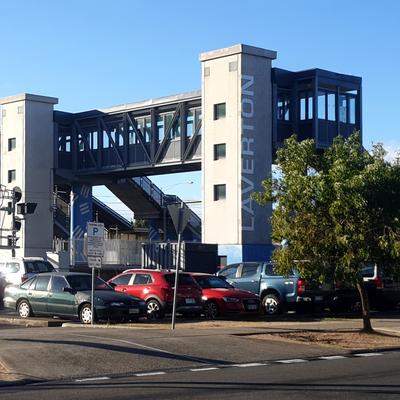
Transport is Laverton's exceptional strength. The suburb features two railway stations on the Werribee line providing direct links to the CBD and surrounding western suburbs, making it one of the best-serviced suburbs in Melbourne's west for public transport. Laverton Station serves the main residential area while Aircraft Station serves the RAAF base and northern industrial areas. The Princes Freeway runs through the suburb providing road access, and Laverton North hosts transport depots, warehouses, and industrial estates that replaced earlier reservations for noxious trades and metropolitan cattle sale yards.
From an investment perspective, Laverton delivers strong rental yields in a context of moderate affordability and modest capital growth. The median house price sits around 600,000 dollars, with units around 579,750 dollars. Rental yields are 3.75 per cent for houses with median weekly rents of 440 dollars, and 5 per cent for units with rents of 480 dollars, making units particularly attractive for investors seeking income. Properties sell within 52 to 65 days on average. House values increased 2.56 per cent over the past year, while unit values rose 13.12 per cent, indicating strong demand for unit accommodation likely driven by affordability and train station proximity. The low owner-occupation rate of 48.3 per cent creates a rental-heavy market, and the high proportion of labourer and machinery operator occupations suggests tenants working in nearby manufacturing and logistics sectors.
Laverton North, the area north of residential Laverton, functions as a separate industrial precinct originally reserved in 1919 for noxious trades and in 1922 for metropolitan cattle sale yards. By 1980 the proximity of residential settlement made these reservations inappropriate, and the area transitioned to transport depots, warehouses, and industrial estates serving Melbourne's western corridor. This creates employment opportunities within walking or short driving distance for Laverton residents but also industrial aesthetics and heavy vehicle traffic on major arterials.
Residents describe Laverton as established and culturally diverse with strong community spirit, generous land sizes relative to newer western suburbs, and strategic positioning between the city and coast. The suburb attracts residents for its transit junction functionality, outdoor activity focus via parks and creek trails, and the Aviation Road precinct's multicultural dining reflecting Indian, Burmese, Thai, and other cuisines. The RAAF base creates stable employment and historical significance as the third oldest base in Australia, and many homes retain characteristics of the 1950s Housing Commission estate and post-WWII cabbage patch era when young families moved in following soldiers' return from conflict.
The trade-offs require clear assessment. Laverton offers exceptional public transport with two train stations providing redundancy and coverage, affordability with houses under 600,000 dollars and strong unit rental yields at 5 per cent, multicultural diversity particularly Indian and Burmese communities creating cultural vibrancy, proximity to RAAF base employment and industrial sector jobs, established streetscapes and generous land sizes predating modern infill density, 17-kilometre distance to CBD making commutes manageable, and creek trails plus baseball stadium providing recreation options. But it delivers lower owner-occupation at 48.3 per cent creating rental-heavy character, 10.5 per cent unemployment rate indicating economic stress, median income 70 per cent of Australian average suggesting socioeconomic disadvantage, industrial aesthetics from Laverton North precinct, loss of community swimming pool despite resident opposition, declining population between 2016-2021 suggesting limited growth momentum compared to neighbouring suburbs, and property aesthetics dominated by older Housing Commission stock and brick-veneer homes lacking contemporary appeal.
The suburb works for tenants prioritising train station walkability and CBD access over car dependence, for labourers and machinery operators working in manufacturing, logistics, and transport sectors with employment nearby, for Indian and Burmese migrants seeking community in suburbs where their culture is represented, for investors seeking unit rental yields at 5 per cent in an established rental market, and for buyers accepting working-class character and industrial adjacency in exchange for affordability and exceptional public transport. It works less well for buyers expecting capital growth matching western growth corridor suburbs, for families requiring modern amenities and contemporary housing stock, for those seeking high owner-occupation neighbourhoods with established community stability, or for residents intolerant of industrial traffic and aesthetics from the Laverton North precinct. What Laverton represents is Melbourne's established industrial working-class west, a suburb built around RAAF base employment and manufacturing sectors, where train access is excellent, where multicultural diversity reflects migration patterns, and where affordability and rental yields attract investors willing to accept socioeconomic challenges and modest capital growth in exchange for transport infrastructure that newer western suburbs cannot match.
The information provided is for general information purposes only and does not constitute legal, financial, or professional advice. While care has been taken to ensure accuracy, the information may not be complete, current, or applicable to your specific situation. You should always do your own research and, where appropriate, seek advice from a qualified professional before making any decisions based on this information.
Looking to buy property in Laverton?
Let's talk about what you're looking for and how we can help. No obligation, no pressure, just an honest conversation about your property goals.
The Laverton property market
Data from Q2 2025 · Victorian Property Sales Report
These charts show median property prices, sales activity, and investment metrics for Laverton. The median price represents the middle value of all sales—half sold for more, half for less—giving a more accurate picture than averages, which can be skewed by unusually high or low sales.
Price History (2013-2023)
Annual median prices showing long-term capital growth trends. Use this to assess how the suburb has performed through different market cycles.
Investment Performance
CAGR (Compound Annual Growth Rate) shows average yearly growth accounting for compounding—a key metric for comparing investment returns.
Q2 2025 Sales Volume
Number of properties sold this quarter. Higher volumes indicate more market activity and reliable pricing data.
Recent Price Changes
Quarterly shows change from last quarter; Annual (YoY) compares to the same quarter last year, smoothing seasonal effects.
Data Sources: Property sales data from Victorian Property Sales Report (Department of Transport and Planning). Rental data from Homes Victoria Rental Report. All data licensed under Creative Commons Attribution 4.0.
Demographics of Laverton
Based on 2021 Australian Census
Age Distribution
Housing Tenure
Income & Housing Costs
| Median Personal Income (weekly) | $738 |
| Median Family Income (weekly) | $1,676 |
| Median Rent (weekly) | $330 |
| Median Mortgage (monthly) | $1,700 |
Top Occupations
Transport to Work
Languages Spoken at Home
| English only | 42.5% |
| Punjabi | 7.3% |
| Karen | 5.5% |
| Hindi | 3.5% |
| Nepali | 3.4% |
| Telugu | 2.6% |
Country of Birth
| Australia | 41.2% |
| India | 15.3% |
| Philippines | 4.6% |
| Myanmar | 3% |
| Nepal | 3% |
| Thailand | 3% |
Dwellings
| Total Dwellings | 2,138 |
| Occupied Dwellings | 1,745 |
| Unoccupied Dwellings | 263 |
Data Source: Australian Bureau of Statistics, 2021 Census of Population and Housing. View full census data →
Schools in Laverton
4 schools found
| School Name | Type | Sector | Year Range | ICSEA | Enrolments |
|---|---|---|---|---|---|
| Jennings Street School | Special | Government | U | 1030 | 118 |
| Laverton P-12 College | Combined | Government | Prep-12 | 932 | 687 |
| Western Autistic School | Special | Government | U | 1053 | 289 |
| St Martin de Porres School | Primary | Catholic | Prep-6 | 1077 | 269 |
Data Source: Australian Curriculum, Assessment and Reporting Authority (ACARA), MySchool data. ICSEA (Index of Community Socio-Educational Advantage) represents the relative socio-educational advantage of students. The average ICSEA score is 1000.
Places of interest in Laverton
- Laverton Swim and Fitness Centre (established 1976, memorial pool)
- Woods Street Art Space
- The Hub Community Centre
- Melbourne Ballpark (state baseball stadium)
- Laverton Railway Station
- Aircraft Railway Station
- Former RAAF Williams Base heritage site
- Laverton Creek parks and sports facilities
- Community shopping centres
Nearby attractions
- Werribee Park Precinct (world-class attractions: Zoo, Mansion, Rose Garden, Equestrian Centre all within easy reach)
- RAAF Museum at Point Cook (Australia's largest military aviation collection, birthplace of RAAF)
- Western Treatment Plant (birdwatching paradise with tens of thousands of birds)
- Werribee River Trail (extensive walking and cycling trail system)
- Cheetham Wetlands (scenic wetlands with city skyline views)
Buyers agent Laverton VIC3028
How long does it take to buy a property in Laverton with a buyers agent?
The property buying process in Laverton typically takes 6-12 weeks from initial consultation to settlement. This includes property search, inspections, due diligence, negotiation, and conveyancing. We work at your pace and ensure you're comfortable with every decision, though we can move quickly when the right property appears.
What's included in your buyer's advocate service in Laverton?
Our comprehensive service in Laverton includes property search, market analysis, inspections, due diligence, negotiation, and auction representation. We coordinate with conveyancers, building inspectors, and other professionals. From your first call through to settlement, we manage every aspect of purchasing property so you can focus on decision-making with confidence.
How do you find properties in Laverton before they're listed publicly?
Our relationships with real estate agents, industry contacts, and local networks in Laverton give us early access to properties before they hit the market. We actively search for off-market opportunities that match your criteria, giving you less competition and often better negotiating leverage than publicly advertised properties.
What should I prepare before starting my property search in Laverton?
Before searching in Laverton, secure pre-approval for your loan, understand your budget including all purchase costs, and clarify your must-haves versus nice-to-haves. We'll discuss your timeline, any constraints, and what success looks like for you. This preparation ensures we can move quickly when the right property appears.
Can you help with properties at different price points in Laverton?
Yes, we work with clients across various budgets in Laverton. Whether you're a first home buyer or purchasing a premium property, our service adapts to your price point. We provide the same thorough approach regardless of budget, ensuring you get the best possible property and outcome for your specific financial situation.